- cross-posted to:
- opensource@programming.dev
- cross-posted to:
- opensource@programming.dev
All my new code will be closed-source from now on. I’ve contributed millions of lines of carefully written OSS code over the past decade, spent thousands of hours helping other people. If you want to use my libraries (1M+ downloads/month) in the future, you have to pay.
I made good money funneling people through my OSS and being recognized as expert in several fields. This was entirely based on HUMANS knowing and seeing me by USING and INTERACTING with my code. No humans will ever read my docs again when coding agents do it in seconds. Nobody will even know it’s me who built it.
Look at Tailwind: 75 million downloads/month, more popular than ever, revenue down 80%, docs traffic down 40%, 75% of engineering team laid off. Someone submitted a PR to add LLM-optimized docs and Wathan had to decline - optimizing for agents accelerates his business’s death. He’s being asked to build the infrastructure for his own obsolescence.
Two of the most common OSS business models:
- Open Core: Give away the library, sell premium once you reach critical mass (Tailwind UI, Prisma Accelerate, Supabase Cloud…)
- Expertise Moat: Be THE expert in your library - consulting gigs, speaking, higher salary
Tailwind just proved the first one is dying. Agents bypass the documentation funnel. They don’t see your premium tier. Every project relying on docs-to-premium conversion will face the same pressure: Prisma, Drizzle, MikroORM, Strapi, and many more.
The core insight: OSS monetization was always about attention. Human eyeballs on your docs, brand, expertise. That attention has literally moved into attention layers. Your docs trained the models that now make visiting you unnecessary. Human attention paid. Artificial attention doesn’t.
Some OSS will keep going - wealthy devs doing it for fun or education. That’s not a system, that’s charity. Most popular OSS runs on economic incentives. Destroy them, they stop playing.
Why go closed-source? When the monetization funnel is broken, you move payment to the only point that still exists: access. OSS gave away access hoping to monetize attention downstream. Agents broke downstream. Closed-source gates access directly. The final irony: OSS trained the models now killing it. We built our own replacement.
My prediction: a new marketplace emerges, built for agents. Want your agent to use Tailwind? Prisma? Pay per access. Libraries become APIs with meters. The old model: free code -> human attention -> monetization. The new model: pay at the gate or your agent doesn’t get in.
You must log in or # to comment.
If only this publication was closed sourced.
Posts code on GitHub (Microsoft) Complains on LinkedIn about AI stealing open source code (Microsoft)
Why would the open source community do this to me???
Lol no I get it, AI is coming to devour us all, and it is just waiting until it can gets enough nourishment from code
What if there was platform that collects money (in a subscription model) and shares equally with all open source contributers? Or: The more you bring to the table, the more you get + other metrics. Like a Netflix for code basically. If you make enough money by your contributions, you get free acccess to code. The price could be so low that everyone would be able to afford it. Or if you upload one open source repo of your own, you get free access.
What we really need are new OS licenses that strike the right balance.
Not a coder, so my opinion is just opinion. The frustrations presented are valid especially with the open push that AI keeps making to remove all parts of the human element to basically everything. Even beyond his points, we have been seeing such massive levels of tech literacy (and even general literacy) even before the massive LLM bubble. AI isn’t “evil” or “bad” but the rush for profits over uses that actually help humanity (plenty of very real accessibility things that could be game changing if profits weren’t the real reason).
Stuff like Vibe Coding and the lack of understanding old systems and why they were done certain ways means we are beyond fucked if anything happens at different levels. The capitalist profits of companies (especially large and mega corps) come from exploitation of their workers and from the communities of OSS.
The following is personal ranting.
Even just working on PCs for regular people is maddening when my younger co-workers that interact with customers we get have basically zero clue as to things many customers are asking help with. Not like any of them or myself should know everything (especially at a retail PC repair level of pay and zero training outside of “make sales”), but even things from PCs a decade ago is over their heads. One easy example off the top of my head, is just knowing that the normal SATA to USB-A adapters don’t work with 3.5" HDDs due to power and they just assume the drive is dead. Hell even just knowing the general file structure of Windows has become a huge issue for both my younger peers and for the customers knowing where their shit is saved. Went from having some knowledge/understanding, to basically thinking shit is “magic” with zero concern for knowing the trick.
No one “easy tip they don’t want you to know” fixes the person in the post’s problems, or for regaining general tech literacy. But capitalism must go to remove the death spiral of making everything profits over people. And education can’t keep being de-funded which leads to students just being “passed” in order to keep the little bits of funding. The students that would be failing should also not be treated like losers, and not make repeating classes such a big deal (or a social shame). It is better to repeat something and learn, than it is to get into “the real world” and have it much much worse (shit was/is already bad enough with people getting promotions into leadership roles that literally don’t know what the shit is about/how things work).
I find it incredible, how uncharitable some of these comments here are. As an open source contributor myself, I also really don’t like the fact, that my work just gets stolen and profited of by big companies without my permission.
Even the nicest, most idealist engineer still needs to be able to live from his work. I am not saying he is, but he is completely within his right to protect his work from abuse.
Free software shouldn’t mean, that every company can use our code in any way, they like and open source licenses still have terms, for example copyleft licenses, like GPLv3, still require work, which is based on that code to be licensed with the same terms and appropriately credited. AI companies are clearly not abiding by these terms and aren’t really prosecuted for that.
We should be angry at the companies misusing our work instead of open source devs who have had enough.
This is the best comment of the thread.
So many people are nitpicking his post or criticizing the platform that he shares it on (let’s me honest, linkedIN has a much wider impact than the fediverse if something “goes corporate viral”). People deserve to be compensated for their work.
We shouldn’t be mad at the devs trying to make a living, even those who have different views about what open source is. We should be banding together against the companies who’s entire business model is based on theft and abuse. New anti-AI licenses specifically, techniques to poison AI data baked into every repo, class action lawsuits against companies, etc…
Once Universal Basic Income gets implemented and you don’t need to be paid directly for your work to survive, then we bicker incessantly about the finer points of the real definition of open source.
Bullhlshit. You think they werent using your libraries before for profit.
Free software shouldnt mean that every company can use our code in anyway they like.
That is exactly what free means. I have never seen people write attributions for nuget or js packages used.
I’m curious how the model of just selling your application that’s GPL’d usually works out. I don’t see it done often. The only one that comes to mind is OSMAnd. There’s also other interesting models for funding public goods like threshold pledge systems, assurance contracts, ransom model, wall street performer protocol, etc.
Doesn’t work with libraries. Though this guy’s rant is pretty silly
I pray Tailwind dies. React too. And JavaScript/TypeScript while we’re at it.
I mean, the elephant in the room is the blatant licence violations orchestrated by LLM vendors. If your codebase is GPLed and serves to feed a LLM, it should extend to all the code produced by that LLM.
For decades, the FOSS community has been at each others throats about those licenses, and now that we contemplate the largest IP theft/reappropriation of all time, it’s like, not big a deal. I can’t tell that I’m a prolific OSS contributor, but enough to understand the sentiment: “I put code in the open to help humanity, not to make oligarchs better off with a newfound mandate to pollute”.
I mean, the elephant in the room is the blatant licence violations orchestrated by LLM vendors. If your codebase is GPLed and serves to feed a LLM, it should extend to all the code produced by that LLM.
This seems so obvious to me, but this is the first time I’ve seen this argument in the wild.
But I guess the AI companies are basically arguing that copyright doesn’t apply to them at all, so it’s moot.
Technically the act of incorporating code into a model’s weights does not trigger GPL’s redistribution clause, so they are legally in the right even though morally you shouldn’t scrape copylefted code into a model that can be used to create non-copylefted code.
Well, once again, that’s just my hot/IANAL take, but when those weights serve to store information in a way that can easily be extracted losslessly (check-out “model extraction attacks”), we should stop treating them as “just weights”.
I agree on a moral standpoint, but unfortunately this does not hold up legally. Even for licenses specifically targeted in addressing AI outputs to count as derivative works like RAIL, I couldn’t find any case of it holding up in a US court. The best course of action might just be to add bot-filtering to whatever Git instance you host your copylefted works on until this issue has a legal solution. I’m curious on the FSF’s stance on AI output counting as derived works and if they’d ever consider a GPLv4 or new license to explicitly target AI. Couldn’t find anything online.
Its not lossless.
Its not lossless.
Except for when it is, and even when it’s not, there is a fine line leading to calling that plagiarism.
check-out “model extraction attacks”
The search results I’m seeing for that term point to people extracting (a clone of) the model, through interacting with the available API of an otherwise closed model. I’m not really seeing anyone interacting with a model to extract its training input data.
Is there a better search term, or do you have a more direct reference to lossless extraction of training data from model weights?
So these weights don’t count as “derived works” because they are not code, but can only be used to generate code (among many other things) in conjunction with an LLM architecture?
most popular oss runs on economic incentives
Citation needed.
Right, Linux kernel development is free, philanthropic work, with zero incentive for profit, funded by IBM, Google… 🙄
Still no?
wheels out Firefox
If Google didn’t foot the bill, Chrome would be your only browser, also, funded by economic incentives. If Firefox exists, there’s no monopoly, which to Google, is why it exists.
One browser to own them all would have made the anti monopoly cases against Google even stronger, and it would have been broken up a decade ago.
I know US antitrust is mostly a joke, but Google has already lost multiple times, and the only question is the scope of the remedies, so this is an easy bit of guesswork.
Question is whether they would lose now with the US government even more captured by special interest and money.
That’s not a citation, only considers two projects, and doesn’t even try to make the claim that the majority is corporate funding, though I checked and apparently that is true for the kernel.
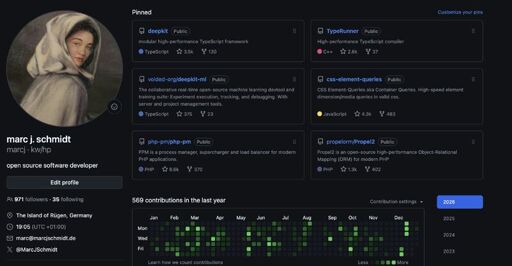
I have no idea who this guy is, but he sounds more like a shareholder/executive than an open source contributor.
He’s authored 60 repos on Github and has forked another 95.
https://github.com/marcj?tab=repositories&q=&type=source&language=&sort=
He also founded companies and used to be CTO: https://www.linkedin.com/in/marc-j-schmidt-957875110
So I suppose he’s both.
That seems like an extremely uncharitable read (to be clear, I don’t know him either).
But he’s not just a “contributor”, I think we need a word that better describes people like him. It sounds like he’s shaped his career and the software he’s written, thoughtfully in the direction of open source.
He’s saying the previously established way of having a career and OSS projects has been broken by the introduction of AI agents.
How are you getting “shareholder”??
tailwind is a product born out of complete ignorance for the fundamental technologies that underlay the web and why they exist the way they do. I hope tailwind’s decline encourages people to learn the fundamentals
i thought this too, and i just started actually working with it and DAMN is it fast… i agree that it’s kinda a technical “what the fuck are you doing?!?” but… yeah… i can’t even really explain why
Huh? How?
I don’t like tailwind personally, but it is just CSS classes.
When you make a website, you can sometimes end up with your own personal library of classnames (like what tailwind is).
Tailwind just goes to the extreme by making you only use classnames and never making your own library of css again.
No shade at all on this guy’s expertise or work, or even the point about LLMs being made. But based on this I’d have to say this is not written by a software developer. This is written by a businessman in the software industry.
Would you say more? Are you saying he hasn’t contributed the open source stuff he claims? Or that someone else wrote this for him? Something else?
No no, nothing like that. There just seems to be a baseline attitude in the blog post that monetization is the end goal of all OSS. Like, the idea that OSS developers deserve to be compensated fairly for their work, I fully support, but I don’t read that as the argument being made here. It reads more as “OSS is no longer a viable way to make money, so I’m going closed-source.”
Okay, I see what you mean. I’m usually pretty sensitive to things that smell like exploitation for financial gain, and it didn’t trigger that response for me.
But after hearing some of the less hostile takes here (like yours) I think I have to acknowledge it’s me, there may be some bias I’m unaware of going into my reading on this one.
Thanks for elaborating.
God forbid a technical person becomes an adult and starts understanding power, money, and politics. Engineers should be babies playing with their toys and being idealistic and irresponsible about their impact on the world.
There’s a big difference between being an adult and seeing everything exclusively through the lens of how it can be used to turn a profit for yourself or some other capitalist.
I think this guy just wants to be payed for all of his work. If big companies start to skip the part of even crediting him for the that they stole without his permission, I can understand his decision to deny them that ability.
Yea it it’s really too bad this guy wants to eat
I’m conflicted on this post. OSS does a lot of good as a whole, but regardless of monetization, I don’t want any of my work training an AI. I can respect that portion of his opinion.
His opinion is actually that AI can use his code no problem, they just have to pay a fee.
The problem is that the big LLM AI companies will just say… ‘Fuck off’, because they don’t like paying for any data, and they also think their models will be advanced enough to write their own libraries soon (if not now, depending how much they believe their own marketing hype).
Pricing is an additional unanswered problem in his new model. As a hypothetical: if 1000 traditional OSS users generate $1000 value in conversion to paid users in his old model - what would an AI license cost? Because one license (eg to Anthropic/Claude) would theoretically be cutting off millions of users, maybe 80%+ of his userbase. Would he ask for millions as a licensing fee?
Whole idea is half-baked IMO, but I am sympathetic to the bullshit situation he finds himself in.
I think this model, however it may work will still be better than what we have currently though. If we can even attempt to charge AI-companies for the training data, that would be a huge step. Because the current model is just they take everything, that they can get their hands on.
And if that makes AI-devellopment ecomically unviable, that’s a really good thing
You’re right. Personally, I’d rather support FOSS development. His justification isn’t 100% right but some of the idea resonates with me.
That just powers big companies more.
Hobby programmers can’t mess around with anything due to the price while companies buy tools, compilers, and libraries as they like??
This reads like they just wanted an excuse about their slowly upcoming greed.