• 33 Posts
  • 45 Comments
Joined 5 months ago
cake
Cake day: August 4th, 2025

help-circle


  • It’s a unsurprising given Canada’s economic relationship with the US which counts for three quarters of Canada’s exports and half of its imports.

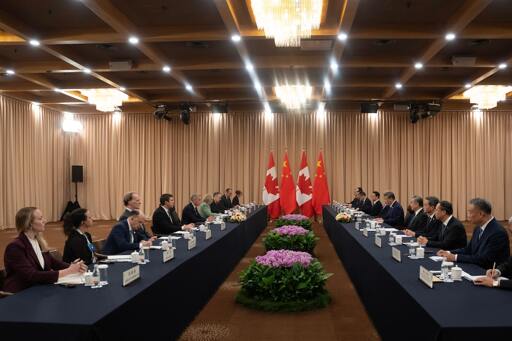
    The report should also be a wake-up call in my opinion that Canada must not rely on any single country for future trade. This week, Carney visits China, and the same Eurasia Group report leaves no doubt about the Chinese economy and the government’s policy. In brief, it says:

    Beijing won’t break out of its deflationary trap this year; instead, it will keep trying to export its way out, flooding global markets with cheap goods at everyone else’s expense.

    The whole report makes a worthwhile read. China has been pursuing coercive trade practices with literally all countries for a long time, showing that it’s not a reliable trade partner. The country is highly dependent, however, on foreign markets to sell its overcapacity made by cheap -and often, forced - labour. (An important detail here is that exactly China’s huge labour force will be tested soon as researchers such as those by the World Economic Forum project an labour force gap in the next decade due to population decline.)

    All these are reasons to diversify trade further away from countries with self-centered governments. To gain at least some degree of predictability in an increasingly uncertain geopolitical landscape, Canada should reach out to its European allies and some in the Indo-Pacific (Australia, New Zealand, Japan, …) and put together a united front against any aggressive actions taken by the U.S. president as much as against autocracies like China and Russia.


  • Take Indonesia. $140B of annual bilateral trade.

    Indonesia suffers a one-way economic dependence from China. Indonesia has a structural trade deficit with China. It also mainly exports commodities (such as oils, mineral fuels, nickel) while high-end products are imported from China (such as machinery, electronic equipment), making it largely impossible for Indonesia to develop its own industry.

    As one study states:

    Significant Chinese investments in Indonesia’s critical minerals and renewable energy sectors have created path dependency, as much of the technological know-how Indonesia sought to acquire for its economic transformation is 75% controlled by Chinese companies. Since these projects rely on Chinese raw materials or midstream processing, this keeps Jakarta’s critical minerals industrial ecosystem tied to Beijing’s technological and financial orbit. Recent developments – including South Korea’s LG Energy Solution withdrawal and the likelihood of its replacement by a Chinese company – indicate that competitive pressure on Chinese firms remains limited and may even be narrowing. Still, this would not change the underlying dependence of Indonesia’s downstream industries on Chinese technology, capital, and supply chains. -[Emphasis mine.]

    This economic dependency will, among others, limit Indonesia political sovereignty. For example, Indonesia will unlikely follow the Philippines’ transparency against China regarding Beijing’s aggression in the South China Sea.

    One report - among many others - on that reads (here is an archived link):

    … The Philippines’ transparency initiative is crucial for addressing and countering disinformation and misinformation, as well as exposing China’s unlawful activities in the South China Sea. Even though Indonesia often faces similar threats from China in the North Natuna Sea, it is less likely to implement such a transparency initiative … Transparency initiatives may not always be a policy choice for other Southeast Asian countries, such as Indonesia … Therefore, while a ‘transparency initiative’ could put pressure on China to comply with international law and avoid reckless behaviour in the South China Sea, Indonesia is less likely to implement such a policy …

    There is much more information about Indonesian-Chinese relationship, and literally all of them point in a similar direction. With Indonesia becoming increasingly dependent on China, Beijing exploits this relationship to achieve not just commercial goals and political coercion, very mich as it does with all of its other ‘partner’ countries.

    You are right in that Indonesia is importing low-cost consumer goods from China, but this doesn’t not “allow better quality of life for people” as you claim. Your statement is wrong. Already in 2024, Indonesia has introduced measures to limit sales of cheap imports on e-commerce platforms such as Shopee, Lazada and TikTok Shop that are hurting local firms.

    This is just a TINY summary of why your claim of Indonesia benefiting from its relationship with China is outright false.


  • Can you tell me how even one of them benefits?

    These are just random lists of companies and countries. Literally all the countries, for example, have been showing increased trade deficits with China, while many trade their commodities and raw materials for high-end goods. Especially in Asia and Africa, they are prone to political and economic coercion (e.g., the Hambantota International Port in Sri Lanka, the country’s second largest port, is owned now by China, which is one reason why Sri Lanka’s government lacks de-facto economic independence).

    Workers’ rights violations are widespread in literally all these countries, aggression against its neighbours on land and at sea. Just to name a few examples.

    The ‘bad faith’ posting comes from you. This list is a very bad joke.


  • Which are China’s allies? Literally all trade partners have increasing deficits, economic and political coercion is widespread, transnational repression has been increasing, China’s interference in domestic affairs and election is strong not only in Canada but everywhere. And that’s just a tiny selection of bad examples.

    Just name one country that ever benefited from a ‘tight relationship’ with China in the long term?

    Which non-Chinese company had ever long-term success in the Chinese domestic market?

    Having said that, the choice is not just between the US and China. Canada must diversify its trade away from both the US and China.


  • For that matter we should start building a much tighter relationship with China overall. They may end up being an ally, as strange as it sounds.

    That’s sounds indeed strange, and it will never become reality. If and when Canada opts for a ‘tighter relationship’ with China, it will only weakens itself. China will use any leverage to bully its so-called ‘allies’ as it has been doing for decades. Canada won’t be an exemption (China’s tariffs on Canadian canola was a good example for this).

    The only option for Canada is a strong diversification of its trade, particularly with democracies in Europe, in the Indo-Pacific, and elsewhere imo.


  • Canada shoudn’t want any mining by foreign entities, no matter what country, because in the end there is always a very real threat of exploitation for the benefit of foreign interests at the expense of Canada. Such ‘annexation’ comes not necessarily by military force, but can also come by political or economic coercion due to dependence on foreign entities or states.

    The US has shown that to Canada already of late. China has been doing that to its ‘partner’ countries all around the globe. Then think of Russia, the former Soviet Union. And all the others now and in history.

    These rare earths and supposedly a lot of other things should become sort of a common good. I don’t have blueprint how to organize that for Canada as it’s very complicated, but it should be public ownership by stakeholders within Canada imo.